IAN WATSON TTN
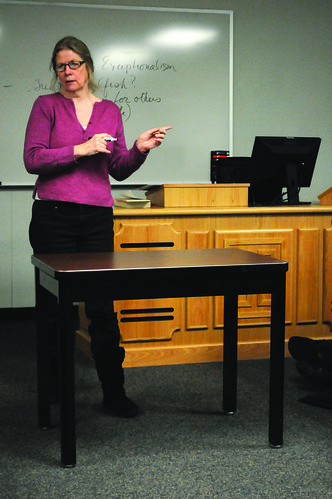
Adjunct professor Carol Jenkins teaching.
Administrators and adjunct instructors discuss how stable the job should be.
In December, 45 adjunct instructors from the English department’s First-Year Writing Program were told they would not be assigned courses come Spring 2011. But the English department isn’t the only area of the university in which adjunct instructors are out of work.
Adjunct instructor Carol Jenkins, of the department of political science, said a number of adjunct instructors weren’t assigned classes in her department.
Jenkins said Richard Deeg, the chair of the department of political science, told her it was because of a change in the policy, informally known as the “gradjunct” policy. But Deeg said the policy is expected to change next year.
“The situation at Temple overall is bad,” Jenkins said. “It seems like it sometimes goes from department to department, depending on how many graduate students there are.”
To read the rest of this news story for The Temple News, click here. If you would like to reprint this article, please email me (rosellaeleanor -at- gmail -dot- com).
Are you worried your resume might cost you that coveted internship? College Magazine to the rescue! Each week in Rejected Resumes, we show your resumes to the experts so you can get to sleep at night. This week, we’re checking out a College Magazine editor’s resume. Although she got the job, she made a few mistakes we’re hoping to save you from making. Here are some tips that apply to every resume:
1. List your most relevant experience first.
Here, the editor's most relevant experience was serving as associate editor on Wooden Teeth literary magazine, which is listed at the end of her activities section.
2. List relevant experience and customer service or retail jobs separately.
In this resume, the applicant lists two jobs in the food industry, and all of her relevant experience is filed under Activities. She should have had a section for Relevant Experience that was separate from her other work and her clubs and activities.
To read the rest of the first Rejected Resumes post, click here.
A review of James Franco's story collection, Palo Alto, that I wrote for two.one.five magazine.
“Halloween,” the opening story in James Franco’s story collection Palo Alto, is told by a grown-up narrator who, in his sophomore year of high school, kills a woman because he drives drunk. In the end of the story, the narrator says he has since driven down the same street where the incident took place and his remembrance of the poor woman’s death is an afterthought. The narrator’s apathy is disturbing and, yet, it almost means nothing.
The narrator of “Halloween” is not conflicted about this childhood tragedy, and neither is there any conflict in the story. The narrator does mention some tension between him and his girlfriend, who he is driving to confront when the mystery woman is hit, but largely, the story slips through the reader’s mind with no great friction to make it stick. “Halloween” reads like a memory put to paper with the intention of writing the real story at some later date.
While Franco’s narrator is clearly years past his adolescent misdeed, his language is not. The composition of his sentences, most of which are loaded down with helping verbs, is sophomoric and fragmentary. The cadence of Franco’s words is abrupt, halting, jarring, and it feels, not like it was a conscious decision made by the writer, but more like simply bad writing. Too many of his sentences read like this: “His professor father had a great liquor cabinet.” Many of the adjectives are vague like “great” and “horrible.” Then there’s Franco’s line: “Ed was half Korean and half white because his mother was Korean and his dad was white from Gary, Indiana.” How perceptive.
The story is weighed down by a lot of unnecessary exposition – like when he writes paragraphs about Ed and Ed’s family while Ed has very little, at all, to do with the story. There are several pages spent on the dynamics of the narrator’s friendships while there are about two sentences that inform the reader that the narrator was on probation when he ran the librarian over. There is no explanation of why and it doesn’t really seem to play into the story – it’s a fairly tangential (at least in practice) revelation. If this story were written by a regular Joe, critics would deride these sequences as throat-clearing and suggest that the writer attend a few more classes at Columbia before publishing again.
In fact, were Franco not a celebrated actor, it’s hard to believe he would have gotten a book deal. The second story in Franco’s collection, “Lockheed,” is told in exactly the same voice as “Halloween” although the narrator of the second story is female. Even the best story in the collection, “April in Three Parts,” which is told in three disjointed sections, disappoints, although the third section of the story has great potential on its own.
BookByte, a new textbook program, guarantees students will get cash back.
With classes starting, students are filling Temple’s bookstore, aiming to rent or buy used and new textbooks. While the green digits on the bookstore’s register may have some students’ eyes bulging, BookByte may have found a solution that will leave students’ wallets heavier.
The Salem, Ore.-based website, which has offered textbooks at a discount since 1999, introduced its “Guaranteed Buyback” program. This program is the first of its kind that ensures the company will buy back its textbooks from students regardless of their condition.
“Textbook rental programs typically charge students significant fees for late, damaged or lost books. In addition to the low upfront price typically found with rental, with ‘Guaranteed Buyback’ students also receive a cash rebate when they return the book to Bookbyte,” Andres Montgomery, the company’s chief strategy officer, said.
To read the rest of this article for The Temple News, click here.
Tim Whitaker, the former editor-in-chief of Philadelphia Weekly, is now the Executive Director of Mighty Writers, a nonprofit based in South Philly that offers workshops and an afterschool program with the aim of improving writing skills in students between the ages of 5 and 17. Whitaker, who wrote droll political and social commentary for his Letters from the Editor at PW, is now sending out entertaining updates on Mighty Writers while surreptitiously seeking donations. We met up with Whitaker before a beef and beer at the Pen & Pencil Club, a fundraiser for the organization he started in association with Rachel Loeper, and we talked about what he’s learned about the world of writing and his favorite reads.
Your program has to teach many different styles of writing, no?
The biggest thing is to teach them to write with clarity. They can layer on the style later.
You've been a professional journalist for many years. Have you ever tried your hand at fiction?
Over the years, I wrote a column for PW about a couple that was a serial. But I never published anything else.
What advice would you give to an aspiring journalist in this day and age?
Besides 'Get out of the business'? We have a lot of tutors who want to be writers and I tell them to give it up unless they absolutely can't picture doing anything else. If it would virtually kill you not to be a writer, then you'll probably make it out okay. It's bleak, though a lot of interesting things are bubbling up.
To read the rest of the interview, check out two.one.five magazine's website.
Columnist Rosella Eleanor LaFevre explores ideas of self discovery in Anna Fields’ book “Confessions of a Rebel Debutante.”
The summer before high school, I had to read three books, one of which was Louisa May Alcott’s “Little Women.” It became one of my favorites, not only because it had been the longest book I had read at the time, but because I felt a connection to the character Jo March.
Since that summer, my favorite books have tended to be the ones with characters I could relate to, especially books about female characters who are as strong-willed and rebellious as March was.
Recently, I had the pleasure to read Anna Fields’ “Confessions of a Rebel Debutante,” which will appear in paperback this February. Fields’ memoir is about a chubby white kid with dreams of being Scarlett O’Hara who grew into a full-fledged rebel debutante living among Yankees.
For Fields’ sophomore year of high school, she transferred from public school to a single-sex boarding school called Wellingham – a place of tradition where girls had various lessons on ladylike behavior and tradition rules.
The high school I attended, Philadelphia High School for Girls, is the only single-sex public school in Philadelphia. I chose it because it was a place where tradition ruled. Like Fields, I believed I could learn better without boys to distract me.
I was mostly right.
To read the rest of this, the first installment of my column "In My Book" for The Temple News, click here.
A review of Cecily von Ziegesar's I Will Always Love You, the final book in the Gossip Girl series, that I wrote for two.one.five magazine.
The final installment in the long-running Gossip Girl series,I Will Always Love You,which features the original cast, is a seriously fun, guilty pleasure read. All the things that readers of the series love are here in this nearly 400-page tome: the shameless label dropping, the sarcastic one-liners, the hook-ups, the ill-timed and ill-advised behavior of Manhattan’s young elite. The book is a fast-paced romp that chronicles the failed romances and friendships of New York’s privileged youth as they navigate the choppy waters of winter breaks spent at home. Blair and Serena are at it again, and over Nate, just like always. Dan and Vanessa are finally together and for good – or so Dan thinks until he finds her in bed with her half-naked T.A. And Jenny is M.I.A. until the last two parts of the book, when she gives Blair and Serena a run for their money with Nate. The real reason this book is a must-read, however, is for the author’s orchestration of language. Von Ziegesar is a master of words. True, the poems she has Dan pen are pretty awful, but her one-line interjections in regular narration and the way she plays with words in general are pleasing to read. It is her way with words what sets von Ziegesar’s series apart from all of the other young adult novels and makes it one that adults will enjoy as well. These are actually literary treasures while other writers, even such YA mainstays as Judy Blume, use too many helping verbs and poorly placed fragments. Instead of telling us how characters feel and leaving us to decide whether we believe it, von Ziegesar makes us feel along with the characters – whether it’s anger at Vanessa for being so foolish or disappointment in Nate for smoking weed and drinking until he can’t remember who he is. Absolutely a must have for those of you who love the TV show or the series.
A review of Or Glory: 21st Century Rockers, a coffee table book, that I wrote for two.one.five magazine.
The people photographer Horst A. Friedrichs captured for the book Or Glory: 21st Century Rockers are not just defined by the music that started the rocker movement in the 1950s but also by their tattoos and reverence for retro clothes and hair styling practices. The book, released by Prestel Publishing, one of the world’s foremost publishers of illustrated books, opens with an interview with two Rock ‘n’ Roll DJs, Cosmic Keith and Sean Peschiera. This interview reveals the simplest history of Rock ‘n’ Roll music possible and there are many names that the average reader’s never heard. More eye opening are the narratives on rocker history from Mark Wilsmore, owner of Ace Café London, and Derek Harris, of Lewis Leathers. Wilsmore talks of the invention of credit giving a young generation the ability to buy fast vehicles (in 1950s England, this meant motorcycles) and thus a roadside entertainment culture was born. Harris refers to his company’s history as an outfitter for aviators and motorists and the company’s segue into motorcycle gear with the invention of the Bronx jacket, which young Englishmen rapidly feasting on pictures of Marlon Brando in The Wild One snapped up. And so you have the beginnings of this still relevant subculture. Friedrichs pictures of tattooed men and women with slicked back and pin-curled hair wearing leather everything and riding traditional English bikes are all striking and a good number of them haunt the viewer long after they’ve closed the hardbound volume. They are pictures to look at again and again. The only thing that’s missing is an explanation of the “59” insignias (this insignia means the wearer is a member of the 59 motorcycle club) and the phrase “Ton Up” (which got its meaning in the early days of motorcycling when going above 100 miles per hour was a great achievement). Or Glory is definitely one for your collection of coffee table books.
As the Fall 2010 semester comes to an end, not all professors are gearing up for spring classes.
Of the 59 adjunct professors who taught courses in the First-Year Writing Program this semester, only 14 will be teaching in Spring 2011. This news came to the 45 adjunct professors, who will lose their current appointments, in a document titled “Spring 2011 First-Year Writing Program Staffing (Projected).”
Although university officials were hesitant to call the announcement a layoff, many of the affected teachers said they feel this is indicative of a rift between the university and its adjunct instructors.
While attempts by the adjuncts to unionize have yet to come to fruition, adjunct faculty members suggest a union could have prevented this situation.
“We’re the last hired, first fired, and this is a continuation of that relationship,” said Frank Fucile, an English instructor who was not assigned to teach any courses next semester.
Read the rest of this news story for The Temple News here.
What you might expect from a film about show business starring two musical icons as the leads: a dippy romp with a spectacular soundtrack. A cross between Moulin Rouge -- which featured a song by Burlesque star Christina Aguilera -- and Chicago with hints of The Devil Wears Prada, director Steve Antin's film offers up plenty of beauty shots of stars Cher and Aguilera and somehow manages to skip over most of the cohesive drama of those instant classics without totally losing the film's momentum.
The film concerns a naïve girl from Iowa named Ali (Aguilera), who travels to Hollywood with grandiose dreams but quickly finds herself in a seedy motel with no job prospects. After a long day of job searching, she stumbles upon a burlesque club owned by Tess (Cher) and is mesmerized. Ali gets a job as a waitress at the club, which is in danger of slipping through Tess' cash-strapped hands, and after auditioning and imploring the hardened Tess, eventually gets a job in the kick line. When an angered fellow performer cuts the music during one of Ali's first shows, Ali belts out a song that blows everyone away. Suddenly, Tess is congratulating her and planning a whole new show that will revolve around her. The music in the film will certainly inspire fans of Aguilera. Cher, whose lip synching is pretty obvious, also gets to belt out a couple of numbers to somewhat lesser effect. Despite the presence of the pros, the most convincing lip-synch belongs to the petite Kristin Bell, who dons a black wig to play the role of Ali's arch enemy Nikki.
Surely, some viewers will be thrown off by the cheesy resolution of the plot's various conflicts – love, debt, the realization of dreams – but everything else about the film is absolutely stunning. The film is visually ravishing in every way, from set design to costumes to lighting, which, in this critic's mind, more than makes up for its lack of narrative originality. You're not going to this movie for subtle shadings of suggestion or nuance of character, you're going for the sass, soundtrack and supreme swagger of its leads. As long as you're good with that, you should have a fine time.
This film review was originally published on two.one.five magazine's website here.
With this doc, based on the book of the same name by Danish environmentalist Bjørn Lomborg, director Ondi Timoner provides a refreshing sequel of sorts for Davis Guggenheim’s An Inconvenient Truth. While avoiding the scare tactics used in the famed 2006 documentary which served to bring global warming and the Earth’s welfare to the forefront of our collective consciousness, Cool It delves into long-term solutions and some temporary stop-gap measures that would cost much less and do much more good than proposed short-term measures to cut carbon dioxide emissions on this planet.
Problematically, Timoner’s film is a bit disjointed. The first 20 minutes are spent on Lomborg’s personal and professional history before moving on to interviews with professors around the world about global warming and possible solutions. Naturally, it also hits on Lomborg’s proposal for spending $250 million on decreasing global warming and addressing the world’s other problems (like lack of health care, lack of education systems and poverty). Perhaps the 20 minutes spent telling Lomborg’s story is meant to mirror the interspersion of Gore’s personal story in Truth, but here, it's more of a distraction, as if interjecting this man's personal story somehow adds a necessarily element of basic individual humanity.
Ultimately, the bulk of the film addresses the world’s future and the solutions that scientists have been studying for years and are ready to implement. In that, it is fascinating stuff to watch, leaving the viewer hopeful rather than glumly preparing for an imminent apocalypse. One can only hope that policy makers are sitting up and taking notes.
This film review was originally published on two.one.five magazine's website.
Recent changes to the TU Alert system focus on the use of the TU Siren.
On Friday, Oct. 14, after a shooting occurred in a residential home on North Warnock Street, just northeast of 11th and Berks streets, a TU Advisory notice was sent via e-mail to inform students, faculty and staff of the incident.
On Sept. 3, the Office of President Ann Weaver Hart approved changes to the TU Alert system, which provides students, faculty and staff with vital information in the event of a campus emergency through one of three ways: a TU Advisory, a TU Alert or the TU Siren.
“What we’ve tried to do is create a system that’s flexible enough so we can relieve the uncertainty associated with certain activities,” Executive Vice President and Chief Financial Officer Anthony Wagner said.
According to the revised Emergency Communication Policy, the university “recognizes its responsibility to provide accurate and timely information to the campus community during emergencies.”
To read the rest of this 700-word news story for The Temple News, click here. The above picture of Lucas Rowe, a freshman civil engineering major, signing up for the alerts was taken by Abigail Reimold.
The two reviews below were part of two.one.five magazine's feature on Philadelphia Film Festival 2010.
11/04/08 Dir. Jeff Deutchman Score: 3.4
Jeff Deutchman, Acquisitions Manager for IFC Films, got the idea for this documentary two weeks before the last presidential election: Why not mass Facebook blast everyone who might have access to a video camera and an interest in recording the events of and reactions to the day that many figured would become an important moment in American history? This listless documentary is the half-baked result. Deutchman's team captured people the world over talking about the change they felt would surely come with Obama's election. Admittedly a great concept, the film fails to capture the excitement and siginficance of that recent moment in U.S. history where liberals, democrats and humanitarians felt a glimmer of hope for their country. Self-professed curator Deutchman pieces together video bits but fails to make them feel cohesive -- the map-jumping seems to have little rhyme or reason. The pacing, too, makes little sense and the climax of the piece -- Obama's winning -- falls more than a tad flat. Instead of elation, the film leaves you feeling sad; for all the supposed change that people thought was on the way, the film's very nature mimics the lack of change in our political system since November 4, 2008.
OC87
Dir. Bud Clayman Score: 6.9
Filmmaker Bud Clayman has suffered from Obsessive-Compulsive Disorder, Bipolar Disorder, Major Depression, and Asperger's almost all of his life. As he was nearing college graduation, he also neared a breakdown that would prevent him from making movies for the next thirty years. With OC87, he reclaims a bit of his dream and in the process, creates, with the help of others, a documentary about his journey for recovery from these mental disorders. From coast to coast, the viewer follows Bud and his team as he retraces the steps in his life. Combining interviews with family members and doctors with old film clips and picture slideshows, Clayman creates an unique and touching story. Characteristic of someone with Asperger's, Clayman doesn't become outwardly emotional but he does seem to change throughout the course of the film, making it wholly captivating and touching.
Many mobile eateries on Main Campus boast their fare is made fresh daily. Some owners try not to let the extra food go to waste.
Even after the lunch trucks close at the end of the day, the quiet hum of freezers can still be heard.
To avoid waste, most truck owners keep meats and other items frozen over night. Most dishes they serve are made to order, according the owners of TJ’s Corner, Silver Eagle and Chicken Heaven.
At TJ’s Corner, which parks on Montgomery Street between Broad and 13th streets, the most popular meals are made with chicken. Approximately 120 pounds of chicken are ordered each week, all of which is kept frozen and prepared to order.
“It takes a little longer, but it’s safer, and you don’t waste,” owner Kevin Doan said.
Read the rest of the news story, written for The Temple News' special Lunchies edition, here.
Essentially, the film is about a man who must reconcile who he thought he was and where he really comes from with the idea he's created of himself, in order to become the man he eventually will be. In the midst of an identity crisis, which follows from learning he is Jewish by birth and not “really” Muslim, Mahmud Nasir (Omid Djalili) lies to his loved ones and endangers everything good in his life. Despite several opportunities to come clean to his beautiful wife Saamiya (Archie Panjabi) and their two children, Mahmud continues to hide his discovery and the fact that he’s taking Jewish lessons with American cabbie Lenny (Richard Schiff) in order to gain access, currently barred by a fanatical Rabbi, to his observant-Jew birth father.
Should he admit to being Jewish, Mahmud would ruin the engagement of his son, Rashid (Amit Shah), to Uzma (Soraya Radford), whose mother has recently married Muslim extremist Arshad Al-Masri. Al-Masri (Igal Naor) who won’t let his new stepdaughter marry a nonbeliever. In other words, the pressure is on for Mahmud to prove he’s a good Muslim. Mahmud attempts to do this by burning a yarmulke at a Justice for Palestine rally where Al-Masri will speak. This act is caught on video and posted online. When Mahmud returns home from a failed attempt to meet his father, Al-Masri is there. He gives the Rashid-Uzma union his blessing and then cops show up to arrest Mahmud for inciting religious hatred. Mahmud must decide if he will risk his son’s happiness and save himself by admitting he is Jewish or accept his arrest.
Despite its heavy subject matter, the film is billed as a comedy, and it improbably succeeds. The juxtaposition of Muslims and Jews provides excellent fodder for comedy. More than that, the movie conveys the message that these warring factions are not so different without being preachy. Just as Mahmud found peace with two conflicting parts of himself, so can the world’s Muslims and Jews – and we can all learn to laugh about our differences.
This film review was originally published on two.one.five magazine's website.
With money tight and jobs scarce, students look to the Internet for ways to make some extra cash.
With the difficulty of finding part-time jobs and open work-study positions on campus, Temple students are turning to alternative money-making ventures, such as text-message Q-and-As, answering surveys, reading paid e-mails, playing games and selling products online.
But with many websites that offer ways to get rich quick, it can be difficult to know which are legitimate. Rachel Brown, the director of the Career Center, said she and her team of counselors can offer advice on how to recognize a scam.
“One of the things we advise students to watch out for is a pyramid scheme and what cost or fees are associated,” Brown said.
Sophomore psychology major Mike Althouse is one of the many students wary of being scammed.
“I know I did something like that before [take surveys online] and I don’t think I got money from it,” he said. “I’m sure a lot of money-making sites have catches, for example, following through with additional requests, et cetera.”
Read the rest of this 850-word feature for The Temple News here.
"Sex: Our Bodies, Our Junk” falls short on humor and helpful sexual information.
There are certain things people should not do in public, and reading the Association for the Betterment of Sex’s book “Sex: Our Bodies, Our Junk” is one of those things. Places you may not want to read the book include your daily commute on SEPTA, your work-study job and your parents’ living room.
Then again, you might not want to read it anywhere unless you are one of the Neanderthals in the 2007 movie “Knocked Up” – who, in the film, say a woman can’t get pregnant if she’s on top – as this book was clearly intended for them. On us upright-walking people, the joke is lost.
Here’s a little about the ABS: It’s a self-professed think tank based in Washington, D.C., comprised of five former and current writers for “The Daily Show,” “Late Night with Conan O’Brien,” Vanity Fair and the Onion. They are Scott Jacobson, Todd Levin, Jason Roeder, Michael Sacks and Ted Travelstead.
Proposed to give the reader a “radical new understanding of sex and intimacy,” the book fails to actually inform the reader of anything sex-related. The handful of tips that aren’t a health risk or a bad joke are things you learned in health class. The whole book reads like a monologue from a misinformed health teacher with a tragic need to be liked by his or her students.
Although ABS’s book was supposedly “exhaustively researched,” it is filled with tidbits quite clearly figments of the imagination. There are some that almost sound truthful, such as “a scant 18 percent of men successfully roll a condom onto their penis in the first try,” until you read, “A man who ejaculates forcefully enough can impregnate the cosmos.”
Read the rest of this 660-word book review for The Temple News here.
Lynn Jacobs and Jeremy Hyman’s “The Secrets of College Success”contains more than 600 tips to improve your college performance.
Dr. Lynn F. Jacobs and Jeremy S. Hyman, creators of the Professors’ Guide series, set out to write “the instruction manual for college.” The result: “The Secrets of College Success,” which was published this past summer.
Their second book is filled with tips for picking classes and professors, improving academic performance and, ultimately, getting more bang out of college for a student’s buck.
“You’re paying a lot of money for this college thing, and if you know what to do, you’ll get your money’s worth,” Hyman said.
Students will get their money’s worth out of the book, too.
Read the rest of this 460-word book review for The Temple News here.
While other universities push students to finish in three years, 67 percent of Temple students take six or more years to graduate.
While debate continues on whether America’s colleges should replace four-year degrees with three-year degrees, Temple is focused on getting students out in four years.
Currently, roughly 67 percent of Temple students take six years or more to graduate, Senior Vice Provost for Undergraduate Studies Peter Jones said.
While schools like Hartwick College in Oneonata, N.Y., are implementing three-year programs and emphasizing the financial benefits for students, Jones explained that he wants students to think of the money they could save by graduating in four years versus five or six.
Tuition for out-of-state students is roughly $40,000 over two years, Jones noted. A student taking six years to graduate loses out on a potential income for two years. That could be $100,000 lost by not graduating on time, Jones said.
To read the rest of this news article for The Temple News, click here. The above picture is of Peter Jones, Vice Provost for Undergraduate Studies. While I did not take this picture, there is no credit on The Temple News' website.
Sergeant Michael Faust, of the Police Athletic League, called Montanna Stewart over to the parked cart at the GEICO Junior Golf Program’s 9-hole tournament on Friday, August 1.
“Do you like it?” Sgt. Faust asked the first-time camper. She nodded vigorously. “Would you come back?” She nodded again.
Stewart is one of roughly 130 inner-city kids from 26 PAL centers who participated in last week’s program at Juniata Golf Course. Many of those kids are returning campers; many, like Stewart, want to return next year.
PAL, for those who don’t know, is a non-profit organization that has served the community since 1947. It operates 26 centers citywide and serves more than 27,000 kids, ages 6 to 18. The organization sponsors sports, educational and cultural events free of charge, including the junior golf program, and provides scholarships to more than 200 recipients a year.
“I’ve enjoyed watching them play and they’re really getting better,” Sgt. Faust said.
Perhaps the reason the kids are improving is because the week spent at Juniata Golf Course is the final phase of PAL’s 3-part junior golf program.
During the introductory phase, which started in early May and lasts 8 weeks, 300 kids were taught the basics at the Burholme Driving Range and Miniature Golf Course. From the end of June to mid-August, roughly 225 kids work on chipping, putting, driving and golf etiquette with the help of golf professionals in the “Kids on the Hill” program.
Then every officer in charge of a PAL center picked 5 kids who spent three days in Juniata learning more from PGA professionals before participating in an 18-hole tournament at the Spring Mill Country Club in Warminster, PA. On the final day of camp, they return to Juniata for a mini-tournament and awards luncheon.
“Everybody gets a medal for participation,” Sgt. Faust said. “It goes over real good, people are happy to have that.”
Those awards were given out by PAL Officer Ernie Rehr, who has led the team operating the camp in the 11 years since Bob Wheeler, one of the founders of the camp, retired. Wheeler is now manager of Juniata Golf Course and has served for the last 3 years as executive director of the Juniata Golf Foundation.
“This is a tremendous program,” retired Officer Wheeler said. “It’s the only legitimate program that teaches inner city kids. We’ve been doing it longer and absolutely better than anyone else.”
Officer Rehr’s nephew Drew was a camper like Stewart and because he agrees with Wheeler’s sentiment, volunteers alongside his dad Andy, a Philadelphia police officer not officially involved with PAL, now that he is too old to participate.
What Officer Rehr wants campers to learn during their week in Juniata are the lessons golf teaches.
“Golf teaches honesty, integrity, dedication, work ethic. I call it the 3 R’s: respect yourself, respect others and respect the course or the environment,” Officer Rehr said. “If you can get a kid to do those things, you’ve got a well-rounded kid.”
Many who have been involved in the camp or seen kids learn those lessons visited last week. Among them were: retired officer Jerry Hartman, who helped Wheeler found the camp; Steve Head, former PAL kid from the 1950s and 1960s; Bobby Ewing, former manager of Juniata Golf Course and PGA golfer; and Dick Smith, former president of PGA who now runs a golf school with Ewing.
The thing Sgt. Faust said is most important is that each kid feels on the course that they’re having fun. “That’s what we want to hear, ‘We’re having fun,’” Sgt. Faust said.
This 530-word piece appeared on the front page of the August 24th edition of The Juniata News. I shot the above picture, of Billy Schneider and Jerry Hartman with junior golfers, using a Nikon point-and-shoot.