Showing posts with label book reviews. Show all posts

Saturday, July 28, 2012

A Love Letter for Beth Kephart

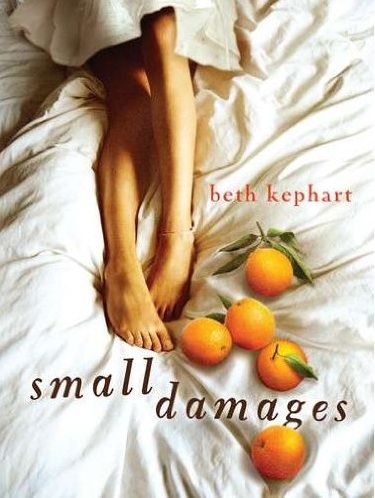
A review of Small Damages, in the form of a letter to its author, Beth Kephart, that was published on M.L.T.S. Magazine's website.

Dear Beth Kephart,

It was a week ago that I wrote on my Facebook that I picked up your newest book, Small Damages, from my mother, to whose apartment it was mistakenly delivered. That night, I started reading it. And slowly, all week, I've savored your words. Your words that float on the tongue, light and tasty as mascarpone cheese laced with lemon curd.

Kenzie's dilemma is one that most young women are terrified of. It is my greatest fear; that I'll find myself "in the family way" before I'm ready, before others think I'm ready. And I know that if it ever happened, my mother would try to make my choices for me. Of course, she wouldn't offer me the option of traveling to Spain. That one is particular to Kenzie's situation.

So from page one, Kenzie had my empathy. And you, Beth, did beautiful things with it. I saw what she saw, heard what she heard, felt what she felt. You took me to Spain. Tossed me into that beautiful place, and while I knew it was horrible that Kenzie's mother sent her there, sort of against her will, I felt like she was incredibly fortunate in this "mistake."

And for all 288 pages, I followed this young girl, whose narration flows in the most beautiful, most poetic of ways but who talks like a normal teenager, and I loved her. I wanted to hug her, tell her it would be okay. I wanted much for this heroine. You had me going, Beth, you tricky angel. But in the end, I was satisfied, like I'd eaten a plateful of paella until I was just starting to feel full.

There's a sense of accomplishment that washes over you when a thick stack of neat, beautiful book pages stands resolutely between your fingers and you know that you've read those words, seen them with your eyes, felt them tremble on your lips, tipping in, sinking in. I'm not sure that feeling is ever stronger than when I held Small Damages, the back cover closed behind the last word, and realized that I'd just come back from Spain, back from a beautiful, lyrical world that I am anxious to dive back into.
You've done it again, you beautiful storyteller, you crafty word-stringer. I can't wait for the next book.

Love, Rosella

Buy Small Damages, Beth Kephart's latest young adult novel, at Amazon. (And please, please, buy the hardback version. It's gorgeously designed and so much more delightful than reading on a screen.)

Tuesday, September 6, 2011

Suggested Reading: Jennifer Rainville's Trance of Insignificance


Every now and then, a woman needs a good friend to smack her upside her head. Certainly, through much of Jennifer Rainville’s self-published novel Trance of Insignificance, readers will feel the urge to slap former TV reporter Jules Duvil around. She’s got everything she could want – a hot career in PR, a good husband – and yet she keeps getting tangled up in her ex-fiancĂ©, the handsome TV news anchor Jack Culligan. In fact, it isn’t really clear why she keeps coming back to him. He calls her “beautiful” and it makes the reader’s skin crawl; how could she be charmed by that most unimaginative of pet names? And how, Lord, how could she sleep with a married man? All the while, her girlfriends casually ask Jules questions about her extramarital affair. If ever a protagonist needed a good friend, it is Jules Duvil. 

Later in the novel, Jules’ mother-in-law Tess tells her that she has something Noah, Jules’ husband, will never have: a sense of self. What does Tess think gives Jules this sense of self? Her tough childhood in Boston, Massachusetts. One can see how trying to get away from your past might lead you to getting wrapped right up in it again, as Jules does repeatedly with fellow Massachusetts native Jack. 

Perhaps because of her questionable judgement, Jules comes off as incredibly real and her story is believeable. It is engaging and thought-provoking. How can we be so stupid when it comes to matters of love and lust? Why do we let our pasts best us, again and again? Can we break our bad habits and find happiness? 

The novel would benefit from a good proofread and occasionally the broadcast journalism technical jargon is distracting, but Rainville’s debut novel provides a captivating tale of a love that her protagonist just can’t seem to let go. 

Tuesday, March 1, 2011

In My Book: Sometimes we must suffer in order to learn

Columnist Rosella LaFevre digs into the struggles faced by "Long Run, Short Catch” author.

Many of us, I believe, have asked the question, “Why me?” When we face tough situations, we wonder why those things had to happened to us. I’m not the only one who has begged for an answer to this question, I am sure.

Asama Iwuoha, a Nigerian-American and the author of the self-published memoir “Long Run, Short Catch: One Woman’s Desperate Attempt to Discover If Normalcy Actually Exists on Earth,” posed this question on the first page of her book.

Iwuoha, whose memoir encompasses the sexual abuse which she suffered as a child and the years she spent as a student here at Temple University, wrote at the start of her memoir that she has never found the answer to this question.

In her book, Iwuoha recalled the time her mother discovered her father in the act and called the police. When her father returned from prison to live with the family, Iwuoha had to learn to deal with his presence. Understandably, she continues to hold a grudge against him, getting fancy clothes and accessories out of him and finally, by marrying a Jamaican man to spite him.

Sometimes, when we ask the question, “Why me?” we seek to absolve ourselves of any guilt, as did Iwuoha. She asks the question without pausing to consider that perhaps her ill-fated marriage happened because she chose to marry a man for the wrong reasons.

As a sophomore at Temple, Iwuoha was finally fitting into a group of girls. One of them introduced her to Michael Williams, a polite Jamaican man. He immediately took a shine to her despite being more into light-skinned girls, as Iwuoha’s account tells us.

His father had brought him to America using someone else’s passport. Advised by his father that marriage would be the quickest way to solve his problems, Williams recognized that Iwuoha could solve his problems and he set out to marry her.

Action was taken so that he might go to college, but it caught up to him when a student enrolled at Temple with the same Social Security number. That was when his father told him he must find a woman to marry and soon after, he met Iwuoha.

They started dating, and soon after, he told her his dilemma. Unsure, she said she’d think about marrying him.

“Is it possible he just wants to use me as his ticket?” Iwuoha wrote. “Either way, marrying him could be my final valediction from father.”

The outcome of the situation is surely undesirable, but this could be the very answer to the Iwuoha’s question.Why should her marriage end the way it did? Perhaps because, as much as Williams was using her for a green card, she was using him to get back at her father.

Often, we beg the question, “Why me?” because we hope that should the answer come to us one way or another, that it will give meaning to our suffering.

Perhaps Iwuoha’s supposed inability to find her answer is because in writing the book, she sought to answer the questions her family had about the choices she made in life.

“Not only does my book entail many of those answers, but it also served as my catharsis, releasing me of emotional baggage that had been haunting me,” Iwuoha said of why she chose to self-publish her story now.

Ultimately, Iwuoha’s book raises more questions for the reader than it answers, but this could be considered its greatest charm. By questioning Iwuoha’s actions, reactions and feelings, we learn that sometimes the answer we’re looking for is right there. And sometimes, it’s not so important why you suffered as how you championed that suffering.

This fourth installment of my book column for The Temple News appeared in today's issue, under a different headline.

Tuesday, February 1, 2011

The journey to self discovery unfolds through ancestors' eyes

Columnist Rosella Eleanor LaFevre sets out to solve the mystery of her grandmother’s past.

There tends to be one question the most introspective people ask themselves at one point or another – “Who am I?” I feel like I’ve been working to figure that out for my entire teenage life.

As far as I can tell, there are several factors that make a person who they are. There’s your name, your childhood, your morals, your family and your friends. These are only parts of the whole equation, but for me, I find a large part of my identity comes from my name: Rosella Eleanor LaFevre.

And for some, such as Lucy Jarrett in the novel “The Lake of Dreams,” by Kim Edwards, part of how we define ourselves is through our family history and our knowledge of our relatives.

To read the rest of the second installment of the "In My Book" column for The Temple News, click here.

Tuesday, January 25, 2011

This Book's Nowhere Near as Hot as Its Author

A review of James Franco's story collection, Palo Alto, that I wrote for two.one.five magazine.


“Halloween,” the opening story in James Franco’s story collection Palo Alto, is told by a grown-up narrator who, in his sophomore year of high school, kills a woman because he drives drunk. In the end of the story, the narrator says he has since driven down the same street where the incident took place and his remembrance of the poor woman’s death is an afterthought. The narrator’s apathy is disturbing and, yet, it almost means nothing.

The narrator of “Halloween” is not conflicted about this childhood tragedy, and neither is there any conflict in the story. The narrator does mention some tension between him and his girlfriend, who he is driving to confront when the mystery woman is hit, but largely, the story slips through the reader’s mind with no great friction to make it stick. “Halloween” reads like a memory put to paper with the intention of writing the real story at some later date.

While Franco’s narrator is clearly years past his adolescent misdeed, his language is not. The composition of his sentences, most of which are loaded down with helping verbs, is sophomoric and fragmentary. The cadence of Franco’s words is abrupt, halting, jarring, and it feels, not like it was a conscious decision made by the writer, but more like simply bad writing. Too many of his sentences read like this: “His professor father had a great liquor cabinet.” Many of the adjectives are vague like “great” and “horrible.” Then there’s Franco’s line: “Ed was half Korean and half white because his mother was Korean and his dad was white from Gary, Indiana.” How perceptive.

The story is weighed down by a lot of unnecessary exposition – like when he writes paragraphs about Ed and Ed’s family while Ed has very little, at all, to do with the story. There are several pages spent on the dynamics of the narrator’s friendships while there are about two sentences that inform the reader that the narrator was on probation when he ran the librarian over. There is no explanation of why and it doesn’t really seem to play into the story – it’s a fairly tangential (at least in practice) revelation. If this story were written by a regular Joe, critics would deride these sequences as throat-clearing and suggest that the writer attend a few more classes at Columbia before publishing again.

In fact, were Franco not a celebrated actor, it’s hard to believe he would have gotten a book deal. The second story in Franco’s collection, “Lockheed,” is told in exactly the same voice as “Halloween” although the narrator of the second story is female. Even the best story in the collection, “April in Three Parts,” which is told in three disjointed sections, disappoints, although the third section of the story has great potential on its own.

Tuesday, January 18, 2011

In My Book: Where you come from is part of who you are

Columnist Rosella Eleanor LaFevre explores ideas of self discovery in Anna Fields’ book “Confessions of a Rebel Debutante.” 

The summer before high school, I had to read three books, one of which was Louisa May Alcott’s “Little Women.” It became one of my favorites, not only because it had been the longest book I had read at the time, but because I felt a connection to the character Jo March.

Since that summer, my favorite books have tended to be the ones with characters I could relate to, especially books about female characters who are as strong-willed and rebellious as March was.

Recently, I had the pleasure to read Anna Fields’ “Confessions of a Rebel Debutante,” which will appear in paperback this February. Fields’ memoir is about a chubby white kid with dreams of being Scarlett O’Hara who grew into a full-fledged rebel debutante living among Yankees.

For Fields’ sophomore year of high school, she transferred from public school to a single-sex boarding school called Wellingham – a place of tradition where girls had various lessons on ladylike behavior and tradition rules.

The high school I attended, Philadelphia High School for Girls, is the only single-sex public school in Philadelphia. I chose it because it was a place where tradition ruled. Like Fields, I believed I could learn better without boys to distract me.

I was mostly right.

To read the rest of this, the first installment of my column "In My Book" for The Temple News, click here.

Monday, January 17, 2011

Stash This in Your Quilted Chanel 2.55


A review of Cecily von Ziegesar's I Will Always Love You, the final book in the Gossip Girl series, that I wrote for two.one.five magazine.

The final installment in the long-running Gossip Girl series, I Will Always Love You, which features the original cast, is a seriously fun, guilty pleasure read. All the things that readers of the series love are here in this nearly 400-page tome: the shameless label dropping, the sarcastic one-liners, the hook-ups, the ill-timed and ill-advised behavior of Manhattan’s young elite. The book is a fast-paced romp that chronicles the failed romances and friendships of New York’s privileged youth as they navigate the choppy waters of winter breaks spent at home. Blair and Serena are at it again, and over Nate, just like always. Dan and Vanessa are finally together and for good – or so Dan thinks until he finds her in bed with her half-naked T.A. And Jenny is M.I.A. until the last two parts of the book, when she gives Blair and Serena a run for their money with Nate. The real reason this book is a must-read, however, is for the author’s orchestration of language. Von Ziegesar is a master of words. True, the poems she has Dan pen are pretty awful, but her one-line interjections in regular narration and the way she plays with words in general are pleasing to read. It is her way with words what sets von Ziegesar’s series apart from all of the other young adult novels and makes it one that adults will enjoy as well. These are actually literary treasures while other writers, even such YA mainstays as Judy Blume, use too many helping verbs and poorly placed fragments. Instead of telling us how characters feel and leaving us to decide whether we believe it, von Ziegesar makes us feel along with the characters – whether it’s anger at Vanessa for being so foolish or disappointment in Nate for smoking weed and drinking until he can’t remember who he is. Absolutely a must have for those of you who love the TV show or the series.

Sunday, January 9, 2011

A little rock for your coffee table?


A review of Or Glory: 21st Century Rockers, a coffee table book, that I wrote for two.one.five magazine.

The people photographer Horst A. Friedrichs captured for the book Or Glory: 21st Century Rockers are not just defined by the music that started the rocker movement in the 1950s but also by their tattoos and reverence for retro clothes and hair styling practices. The book, released by Prestel Publishing, one of the world’s foremost publishers of illustrated books, opens with an interview with two Rock ‘n’ Roll DJs, Cosmic Keith and Sean Peschiera. This interview reveals the simplest history of Rock ‘n’ Roll music possible and there are many names that the average reader’s never heard. More eye opening are the narratives on rocker history from Mark Wilsmore, owner of Ace CafĂ© London, and Derek Harris, of Lewis Leathers. Wilsmore talks of the invention of credit giving a young generation the ability to buy fast vehicles (in 1950s England, this meant motorcycles) and thus a roadside entertainment culture was born. Harris refers to his company’s history as an outfitter for aviators and motorists and the company’s segue into motorcycle gear with the invention of the Bronx jacket, which young Englishmen rapidly feasting on pictures of Marlon Brando in The Wild One snapped up. And so you have the beginnings of this still relevant subculture. Friedrichs pictures of tattooed men and women with slicked back and pin-curled hair wearing leather everything and riding traditional English bikes are all striking and a good number of them haunt the viewer long after they’ve closed the hardbound volume. They are pictures to look at again and again. The only thing that’s missing is an explanation of the “59” insignias (this insignia means the wearer is a member of the 59 motorcycle club) and the phrase “Ton Up” (which got its meaning in the early days of motorcycling when going above 100 miles per hour was a great achievement). Or Glory is definitely one for your collection of coffee table books.

Monday, September 13, 2010

Sex manual comes up short on advice

"Sex: Our Bodies, Our Junk” falls short on humor and helpful sexual information.

There are certain things people should not do in public, and reading the Association for the Betterment of Sex’s book “Sex: Our Bodies, Our Junk” is one of those things. Places you may not want to read the book include your daily commute on SEPTA, your work-study job and your parents’ living room.

Then again, you might not want to read it anywhere unless you are one of the Neanderthals in the 2007 movie “Knocked Up” – who, in the film, say a woman can’t get pregnant if she’s on top – as this book was clearly intended for them. On us upright-walking people, the joke is lost.

Here’s a little about the ABS: It’s a self-professed think tank based in Washington, D.C., comprised of five former and current writers for “The Daily Show,” “Late Night with Conan O’Brien,” Vanity Fair and the Onion. They are Scott Jacobson, Todd Levin, Jason Roeder, Michael Sacks and Ted Travelstead.

Proposed to give the reader a “radical new understanding of sex and intimacy,” the book fails to actually inform the reader of anything sex-related. The handful of tips that aren’t a health risk or a bad joke are things you learned in health class. The whole book reads like a monologue from a misinformed health teacher with a tragic need to be liked by his or her students.

Although ABS’s book was supposedly “exhaustively researched,” it is filled with tidbits quite clearly figments of the imagination. There are some that almost sound truthful, such as “a scant 18 percent of men successfully roll a condom onto their penis in the first try,” until you read, “A man who ejaculates forcefully enough can impregnate the cosmos.”


Read the rest of this 660-word book review for The Temple News here.

Monday, September 6, 2010

Professors’ guide unlocks the secrets to earning A’s

Lynn Jacobs and Jeremy Hyman’s “The Secrets of College Success”contains more than 600 tips to improve your college performance.

Dr. Lynn F. Jacobs and Jeremy S. Hyman, creators of the Professors’ Guide series, set out to write “the instruction manual for college.” The result: “The Secrets of College Success,” which was published this past summer.

Their second book is filled with tips for picking classes and professors, improving academic performance and, ultimately, getting more bang out of college for a student’s buck.

“You’re paying a lot of money for this college thing, and if you know what to do, you’ll get your money’s worth,” Hyman said.

Students will get their money’s worth out of the book, too.

Read the rest of this 460-word book review for The Temple News here.