Columnist Rosella LaFevre digs into the struggles faced by "Long Run, Short Catch” author.
Many of us, I believe, have asked the question, “Why me?” When we face tough situations, we wonder why those things had to happened to us. I’m not the only one who has begged for an answer to this question, I am sure.
Asama Iwuoha, a Nigerian-American and the author of the self-published memoir “Long Run, Short Catch: One Woman’s Desperate Attempt to Discover If Normalcy Actually Exists on Earth,” posed this question on the first page of her book.
Iwuoha, whose memoir encompasses the sexual abuse which she suffered as a child and the years she spent as a student here at Temple University, wrote at the start of her memoir that she has never found the answer to this question.
In her book, Iwuoha recalled the time her mother discovered her father in the act and called the police. When her father returned from prison to live with the family, Iwuoha had to learn to deal with his presence. Understandably, she continues to hold a grudge against him, getting fancy clothes and accessories out of him and finally, by marrying a Jamaican man to spite him.
Sometimes, when we ask the question, “Why me?” we seek to absolve ourselves of any guilt, as did Iwuoha. She asks the question without pausing to consider that perhaps her ill-fated marriage happened because she chose to marry a man for the wrong reasons.
As a sophomore at Temple, Iwuoha was finally fitting into a group of girls. One of them introduced her to Michael Williams, a polite Jamaican man. He immediately took a shine to her despite being more into light-skinned girls, as Iwuoha’s account tells us.
His father had brought him to America using someone else’s passport. Advised by his father that marriage would be the quickest way to solve his problems, Williams recognized that Iwuoha could solve his problems and he set out to marry her.
Action was taken so that he might go to college, but it caught up to him when a student enrolled at Temple with the same Social Security number. That was when his father told him he must find a woman to marry and soon after, he met Iwuoha.
They started dating, and soon after, he told her his dilemma. Unsure, she said she’d think about marrying him.
“Is it possible he just wants to use me as his ticket?” Iwuoha wrote. “Either way, marrying him could be my final valediction from father.”
The outcome of the situation is surely undesirable, but this could be the very answer to the Iwuoha’s question.Why should her marriage end the way it did? Perhaps because, as much as Williams was using her for a green card, she was using him to get back at her father.
Often, we beg the question, “Why me?” because we hope that should the answer come to us one way or another, that it will give meaning to our suffering.
Perhaps Iwuoha’s supposed inability to find her answer is because in writing the book, she sought to answer the questions her family had about the choices she made in life.
“Not only does my book entail many of those answers, but it also served as my catharsis, releasing me of emotional baggage that had been haunting me,” Iwuoha said of why she chose to self-publish her story now.
Ultimately, Iwuoha’s book raises more questions for the reader than it answers, but this could be considered its greatest charm. By questioning Iwuoha’s actions, reactions and feelings, we learn that sometimes the answer we’re looking for is right there. And sometimes, it’s not so important why you suffered as how you championed that suffering.
This fourth installment of my book column for The Temple News appeared in today's issue, under a different headline.
Showing posts with label The Temple News. Show all posts
Showing posts with label The Temple News. Show all posts
Tuesday, March 1, 2011


Monday, February 14, 2011
In My Book: Trading others' support for a path toward self-guidance

Leaving our high school lives behind for college means a lot of change – at least it did for me. A childhood spent on campus with a parent who works at Temple meant adjusting to college life wasn’t that hard.
Only, I hadn’t counted on how lonely I would be without my best friend. Adjusting to life without your support system is hard, as Julia Goodman, the narrator of Susan Shapiro’s touching first novel “Speed Shrinking” would tell you.
The novel opens with an announcement from her best friend, Sarah, that she will leave New York City after her wedding that weekend. That same day, Goodman’s husband Jake told her he was departing for TV work in Los Angeles, and at her weekly appointment, her beloved shrink Dr. Ness divulged plans to move to the Midwest.
With all three of her “pillars” leaving, Goodman, the Manhattan self-help author, is in a tizzy. What will she do without them?
To read the rest of the third installment of "In My Book," click here.
Tuesday, February 1, 2011
The journey to self discovery unfolds through ancestors' eyes
There tends to be one question the most introspective people ask themselves at one point or another – “Who am I?” I feel like I’ve been working to figure that out for my entire teenage life.
As far as I can tell, there are several factors that make a person who they are. There’s your name, your childhood, your morals, your family and your friends. These are only parts of the whole equation, but for me, I find a large part of my identity comes from my name: Rosella Eleanor LaFevre.
And for some, such as Lucy Jarrett in the novel “The Lake of Dreams,” by Kim Edwards, part of how we define ourselves is through our family history and our knowledge of our relatives.
To read the rest of the second installment of the "In My Book" column for The Temple News, click here.
The Temple News: Debating the adjuncts' role
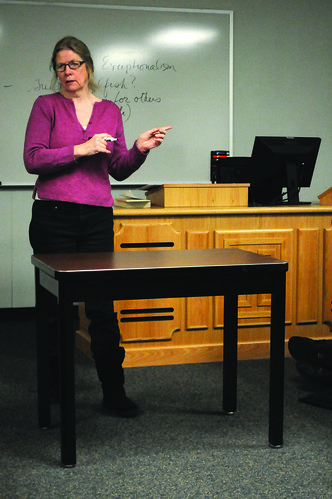 |
| IAN WATSON TTN Adjunct professor Carol Jenkins teaching. |
In December, 45 adjunct instructors from the English department’s First-Year Writing Program were told they would not be assigned courses come Spring 2011. But the English department isn’t the only area of the university in which adjunct instructors are out of work.
Adjunct instructor Carol Jenkins, of the department of political science, said a number of adjunct instructors weren’t assigned classes in her department.
Jenkins said Richard Deeg, the chair of the department of political science, told her it was because of a change in the policy, informally known as the “gradjunct” policy. But Deeg said the policy is expected to change next year.
“The situation at Temple overall is bad,” Jenkins said. “It seems like it sometimes goes from department to department, depending on how many graduate students there are.”
To read the rest of this news story for The Temple News, click here. If you would like to reprint this article, please email me (rosellaeleanor -at- gmail -dot- com).
Tuesday, January 25, 2011
Buyback program makes textbook buying less risky
BookByte, a new textbook program, guarantees students will get cash back.
With classes starting, students are filling Temple’s bookstore, aiming to rent or buy used and new textbooks. While the green digits on the bookstore’s register may have some students’ eyes bulging, BookByte may have found a solution that will leave students’ wallets heavier.
The Salem, Ore.-based website, which has offered textbooks at a discount since 1999, introduced its “Guaranteed Buyback” program. This program is the first of its kind that ensures the company will buy back its textbooks from students regardless of their condition.
“Textbook rental programs typically charge students significant fees for late, damaged or lost books. In addition to the low upfront price typically found with rental, with ‘Guaranteed Buyback’ students also receive a cash rebate when they return the book to Bookbyte,” Andres Montgomery, the company’s chief strategy officer, said.
To read the rest of this article for The Temple News, click here.
Tuesday, January 18, 2011
In My Book: Where you come from is part of who you are
Columnist Rosella Eleanor LaFevre explores ideas of self discovery in Anna Fields’ book “Confessions of a Rebel Debutante.”
The summer before high school, I had to read three books, one of which was Louisa May Alcott’s “Little Women.” It became one of my favorites, not only because it had been the longest book I had read at the time, but because I felt a connection to the character Jo March.
 Since that summer, my favorite books have tended to be the ones with characters I could relate to, especially books about female characters who are as strong-willed and rebellious as March was.
Recently, I had the pleasure to read Anna Fields’ “Confessions of a Rebel Debutante,” which will appear in paperback this February. Fields’ memoir is about a chubby white kid with dreams of being Scarlett O’Hara who grew into a full-fledged rebel debutante living among Yankees.
For Fields’ sophomore year of high school, she transferred from public school to a single-sex boarding school called Wellingham – a place of tradition where girls had various lessons on ladylike behavior and tradition rules.
The high school I attended, Philadelphia High School for Girls, is the only single-sex public school in Philadelphia. I chose it because it was a place where tradition ruled. Like Fields, I believed I could learn better without boys to distract me.
I was mostly right.
To read the rest of this, the first installment of my column "In My Book" for The Temple News, click here.
The summer before high school, I had to read three books, one of which was Louisa May Alcott’s “Little Women.” It became one of my favorites, not only because it had been the longest book I had read at the time, but because I felt a connection to the character Jo March.
Since that summer, my favorite books have tended to be the ones with characters I could relate to, especially books about female characters who are as strong-willed and rebellious as March was.Recently, I had the pleasure to read Anna Fields’ “Confessions of a Rebel Debutante,” which will appear in paperback this February. Fields’ memoir is about a chubby white kid with dreams of being Scarlett O’Hara who grew into a full-fledged rebel debutante living among Yankees.
For Fields’ sophomore year of high school, she transferred from public school to a single-sex boarding school called Wellingham – a place of tradition where girls had various lessons on ladylike behavior and tradition rules.
The high school I attended, Philadelphia High School for Girls, is the only single-sex public school in Philadelphia. I chose it because it was a place where tradition ruled. Like Fields, I believed I could learn better without boys to distract me.
I was mostly right.
To read the rest of this, the first installment of my column "In My Book" for The Temple News, click here.
Monday, December 6, 2010
Adjunct 'layoffs' increase concern
As the Fall 2010 semester comes to an end, not all professors are gearing up for spring classes.
Of the 59 adjunct professors who taught courses in the First-Year Writing Program this semester, only 14 will be teaching in Spring 2011. This news came to the 45 adjunct professors, who will lose their current appointments, in a document titled “Spring 2011 First-Year Writing Program Staffing (Projected).”
Although university officials were hesitant to call the announcement a layoff, many of the affected teachers said they feel this is indicative of a rift between the university and its adjunct instructors.
While attempts by the adjuncts to unionize have yet to come to fruition, adjunct faculty members suggest a union could have prevented this situation.
“We’re the last hired, first fired, and this is a continuation of that relationship,” said Frank Fucile, an English instructor who was not assigned to teach any courses next semester.
Read the rest of this news story for The Temple News here.
Of the 59 adjunct professors who taught courses in the First-Year Writing Program this semester, only 14 will be teaching in Spring 2011. This news came to the 45 adjunct professors, who will lose their current appointments, in a document titled “Spring 2011 First-Year Writing Program Staffing (Projected).”
Although university officials were hesitant to call the announcement a layoff, many of the affected teachers said they feel this is indicative of a rift between the university and its adjunct instructors.
“We’re the last hired, first fired, and this is a continuation of that relationship,” said Frank Fucile, an English instructor who was not assigned to teach any courses next semester.
Read the rest of this news story for The Temple News here.
Tuesday, October 26, 2010
Hart approves changes to TU Alert system

On Friday, Oct. 14, after a shooting occurred in a residential home on North Warnock Street, just northeast of 11th and Berks streets, a TU Advisory notice was sent via e-mail to inform students, faculty and staff of the incident.
On Sept. 3, the Office of President Ann Weaver Hart approved changes to the TU Alert system, which provides students, faculty and staff with vital information in the event of a campus emergency through one of three ways: a TU Advisory, a TU Alert or the TU Siren.
“What we’ve tried to do is create a system that’s flexible enough so we can relieve the uncertainty associated with certain activities,” Executive Vice President and Chief Financial Officer Anthony Wagner said.
According to the revised Emergency Communication Policy, the university “recognizes its responsibility to provide accurate and timely information to the campus community during emergencies.”
To read the rest of this 700-word news story for The Temple News, click here.
The above picture of Lucas Rowe, a freshman civil engineering major, signing up for the alerts was taken by Abigail Reimold.
Monday, September 27, 2010
Left-over lunch's cycle
Many mobile eateries on Main Campus boast their fare is made fresh daily. Some owners try not to let the extra food go to waste.
Even after the lunch trucks close at the end of the day, the quiet hum of freezers can still be heard.
To avoid waste, most truck owners keep meats and other items frozen over night. Most dishes they serve are made to order, according the owners of TJ’s Corner, Silver Eagle and Chicken Heaven.
At TJ’s Corner, which parks on Montgomery Street between Broad and 13th streets, the most popular meals are made with chicken. Approximately 120 pounds of chicken are ordered each week, all of which is kept frozen and prepared to order.
“It takes a little longer, but it’s safer, and you don’t waste,” owner Kevin Doan said.
Read the rest of the news story, written for The Temple News' special Lunchies edition, here.
Monday, September 13, 2010
Dorm Corp.
With money tight and jobs scarce, students look to the Internet for ways to make some extra cash.
With the difficulty of finding part-time jobs and open work-study positions on campus, Temple students are turning to alternative money-making ventures, such as text-message Q-and-As, answering surveys, reading paid e-mails, playing games and selling products online.
But with many websites that offer ways to get rich quick, it can be difficult to know which are legitimate. Rachel Brown, the director of the Career Center, said she and her team of counselors can offer advice on how to recognize a scam.
“One of the things we advise students to watch out for is a pyramid scheme and what cost or fees are associated,” Brown said.
Sophomore psychology major Mike Althouse is one of the many students wary of being scammed.
“I know I did something like that before [take surveys online] and I don’t think I got money from it,” he said. “I’m sure a lot of money-making sites have catches, for example, following through with additional requests, et cetera.”
Read the rest of this 850-word feature for The Temple News here.
Sex manual comes up short on advice
"Sex: Our Bodies, Our Junk” falls short on humor and helpful sexual information.
There are certain things people should not do in public, and reading the Association for the Betterment of Sex’s book “Sex: Our Bodies, Our Junk” is one of those things. Places you may not want to read the book include your daily commute on SEPTA, your work-study job and your parents’ living room.
Then again, you might not want to read it anywhere unless you are one of the Neanderthals in the 2007 movie “Knocked Up” – who, in the film, say a woman can’t get pregnant if she’s on top – as this book was clearly intended for them. On us upright-walking people, the joke is lost.
Here’s a little about the ABS: It’s a self-professed think tank based in Washington, D.C., comprised of five former and current writers for “The Daily Show,” “Late Night with Conan O’Brien,” Vanity Fair and the Onion. They are Scott Jacobson, Todd Levin, Jason Roeder, Michael Sacks and Ted Travelstead.
Proposed to give the reader a “radical new understanding of sex and intimacy,” the book fails to actually inform the reader of anything sex-related. The handful of tips that aren’t a health risk or a bad joke are things you learned in health class. The whole book reads like a monologue from a misinformed health teacher with a tragic need to be liked by his or her students.
Although ABS’s book was supposedly “exhaustively researched,” it is filled with tidbits quite clearly figments of the imagination. There are some that almost sound truthful, such as “a scant 18 percent of men successfully roll a condom onto their penis in the first try,” until you read, “A man who ejaculates forcefully enough can impregnate the cosmos.”
Read the rest of this 660-word book review for The Temple News here.
Monday, September 6, 2010
Professors’ guide unlocks the secrets to earning A’s
Lynn Jacobs and Jeremy Hyman’s “The Secrets of College Success”contains more than 600 tips to improve your college performance.
Dr. Lynn F. Jacobs and Jeremy S. Hyman, creators of the Professors’ Guide series, set out to write “the instruction manual for college.” The result: “The Secrets of College Success,” which was published this past summer.
Their second book is filled with tips for picking classes and professors, improving academic performance and, ultimately, getting more bang out of college for a student’s buck.
“You’re paying a lot of money for this college thing, and if you know what to do, you’ll get your money’s worth,” Hyman said.
Students will get their money’s worth out of the book, too.
Read the rest of this 460-word book review for The Temple News here.
Tuesday, August 31, 2010
Accelerated programs help combat delayed graduation

While other universities push students to finish in three years, 67 percent of Temple students take six or more years to graduate.
While debate continues on whether America’s colleges should replace four-year degrees with three-year degrees, Temple is focused on getting students out in four years.
Currently, roughly 67 percent of Temple students take six years or more to graduate, Senior Vice Provost for Undergraduate Studies Peter Jones said.
While schools like Hartwick College in Oneonata, N.Y., are implementing three-year programs and emphasizing the financial benefits for students, Jones explained that he wants students to think of the money they could save by graduating in four years versus five or six.
Tuition for out-of-state students is roughly $40,000 over two years, Jones noted. A student taking six years to graduate loses out on a potential income for two years. That could be $100,000 lost by not graduating on time, Jones said.
To read the rest of this news article for The Temple News, click here. The above picture is of Peter Jones, Vice Provost for Undergraduate Studies. While I did not take this picture, there is no credit on The Temple News' website.
Monday, April 5, 2010
Adjuncts make strides in fight to unionize
Supporters recently made strides in the fight to gain union representation for roughly 1,300 part-time faculty members at Temple.
The Adjunct Organizing Committee’s collection of signature cards from part-time faculty members began with a two-day kickoff drive the end of last month.
These cards would authorize the Pennsylvania Labor Relations Board to hold an election to incorporate adjuncts into the Temple Association of University Professionals union. TAUP, an affiliate of the American Federation of Teachers, has supported the AOC through its struggle for union representation.
Last semester, the AOC declared the week of Nov. 20 the first Adjunct Awareness Week and members stood at the Bell Tower to spread the message that nearly 50 percent of Temple’s faculty had no means of collective bargaining or otherwise ensuring fair treatment.
To read the rest of this article, published as an online exclusive for The Temple News, click here.
Tuesday, March 30, 2010
Shop Class: Connections of vintage love in Philadelphia

Fashion columnist Rosella Eleanor LaFevre finds the vintage jackpot in Queen's Village.
My love for vintage started in sixth grade when I realized dressing like the so-called popular girls would never make me one of them. This is also about the time I learned Gwen Stefani had scoured thrift stores as a high school student wearing men’s pajama bottoms she had pegged herself.
After forcing my mother to take me to a thrift store, I had a religious experience. There were rows and rows of clothing, and each piece was different from the others – as different as I was from every girl in my class.
Since fondling fur coats and trying on men’s vests in that thrift store, I have loved vintage for its increased power of expression and for the stories woven into every fiber. Recently, I took a walk around Queen’s Village and found four incredible vintage emporiums just south of South Street.
Read the rest of my fifth "Shop Class" column for The Temple News here.
Tuesday, March 16, 2010
Shop Class: Love in the hands of a Claddagh ring
Toast to love this St. Patrick’s Day with the Irish ring. Its origin and purpose dates back to love.
I am not Irish, but growing up with two very proud Irish Catholic cousins, I can appreciate the culture.
In high school I even joined Irish Club, and although I only went to a handful of meetings, I spent $25 on a black hooded sweatshirt that had my last name printed on the back and that proclaimed I was a member.
On the topic of St. Patrick’s Day accessories, I had no clue what to suggest other than telling you to take a trip to the Party City located at 330 Oregon Ave. There, you can stock up on sparkly green top hats and four-leaf clover-shaped beaded necklaces.
Then I thought about that Irish Club hooded sweatshirt and the design on the chest. It was a simple drawing of the Irish ring. I knew the design – a crowned heart held by two hands – but did not know the name.
Its proper name is the claddagh ring. I cannot properly pronounce the word, but at least I can spell it.
To read the rest of the article for The Temple News, click here.
Tuesday, February 23, 2010
Shop Class: Spring into this season...

Rosella LaFevre lays out the dos and don'ts of spring fashion this year, so ladies on campus can look their best while soaking up some sun.
This winter, a nearly unanimous – if objectionable – vote by my lovely peers in favor of a comfortable three-piece ensemble had many them traipsing through the snow in North Face jackets, leggings-as-pants and Ugg boots.
This spring you can, and should, be just as comfortable in a softer, more feminine look. Think sundresses and cropped blazers, sun hats and brand-spanking-new white Keds sneakers. Consider Sookie Stackhouse from HBO’s True Blood your warm weather style sister.
Sookie Stackhouse, played by a beautifully blonde Anna Pacquin, is a waitress at a bar in Louisiana’s Bon Temp who happens to wind up dating a vampire for those of you who don’t know. She favors sundresses and cardigans and other style choices appropriate for a ladylike southern belle.
“I’ve shopped for most of the cast at Walmart, Kohl’s, Kmart, JCPenney, Sears – all the stores that real people from Bon Temps could afford,” Audrey Fisher, the show’s stylist, told Amy Wilkinson with MTV’s Hollywood Crush.
To read the rest of my third fashion column "Shop Class" for The Temple News, click here.
Monday, February 8, 2010
Learning to love ‘me’ and not ‘we’

As Rosella Eleanor LaFevre reveals in her essay, love starts closer than expected – with yourself.
I have had a smattering of blips on the relationship radar and, in addition, one fairly serious – if brief – relationship. And somehow, I always end up alone come Valentine’s Day. This year, I will not complain. Rather, I will celebrate.
After years of exposure to the fairy tale and its grown-up naïve sister, the romantic comedy, I am finally past wishing for nothing more than a guy to set my life straight.
After years of pining for a Prince Charming or a Patrick Verona, I am sure that being in love with myself is enough.
I’m not talking about an unhealthy kind of self-love. The love that I am referring to is respect for my idiosyncrasies and a belief that no one’s opinion of me should outweigh my own. I mean believing in myself enough to take risks and to live my life without fearing that people might see me in a different way than I want them to.
Read the rest of this essay for the Valentine's Day-themed issue of The Temple News here.
Tuesday, January 26, 2010
Shop Class: Peace Images jewelry designer helping Haiti

Fashion columnist covers jewelry designer donating proceeds to Wyclef Jean’s Yéle Foundation.
Since the time my mom braided a hemp necklace for me and I learned to make bracelets out of gimp, or scoubidou, at Girl Scout camp, I have been a fan of handmade jewelry.
But Camille Peace’s designs, under her label Peace Images, are much more elegant than those ropey accessories of my past. And they better satisfy my philanthropic urges, as a portion of the designer’s proceeds, through the end of January, go to the Haiti relief efforts.
Peace is donating 25 percent of her profits from Peace Images sales on Etsy to Wyclef Jean’s Yéle Foundation. Peace, who is Haitian herself, felt a responsibility to help the victims of the 7.0 magnitude earthquake that struck on Jan. 12 and centered on Port-au-Prince’s coast.
“They are my people,” Peace said in an e-mail. “How can I not help? And for the first time, I was in a position where I could help on a large scale.”
To read the rest of my first fashion column for The Temple News, please click here.
Tuesday, December 8, 2009
New Cera film a fun, youthful ride

The burgeoning actor, who visited Main Campus last week, stars in an irresistable comedy.
On the Youth in Revolt poster, Portia Doubleday looks like Lolita, donning red sunglasses and holding a red lollipop. One can see how she, as Sheeni Saunders, might lead the opposite sex into trouble as the young beauty of Vladimir Nabokov’s novel once did.
And lead them into trouble, Sheeni does. Nick Twisp, played by Michael Cera, who recently visited Main Campus to premier the film, falls for the 17-year-old free spirit and in an effort to win her affections and – more importantly to the virgin Nick – get into her pants, decides to rebel against the forces that keep them apart.
Youth in Revolt, Miguel Arteta’s adaptation of C.D. Payne’s novels about Nick Twisp’s adventures, features some of Cera’s best acting yet. In it, Arteta has mastered the art of taking the pain of young love and making it all at once realistic, touching, hilarious and outrageous.
View the rest of this film review for The Temple News here.
Subscribe to:
Posts (Atom)